
TESTING
YOUR
EMOTIONS
AND HOW YOU CAN APPLY SOME
PERSONAL LEADERSHIP TO KEEP THEM
UNDER CONTROL…
© Stephen Janaway 2014
WHO AM I?
STEPHEN JANAWAY
•  14 years experience in mobile software testing.
•  Software testing and test management.
•  Main focus on the mobile device and
applications area.
•  Have worked for companies such as Ericsson,
Motorola and Nokia.
www.stephenjanaway.co.uk @stephenjanaway
© Stephen Janaway 2014
THANKS TO….
•  Robert Plutchik.
•  Hugo Lövheim.
•  Jerry Weinberg.
•  Michael Bolton.
•  And many more….
•  And some cats.
© Stephen Janaway 2014
WHY?
BECAUSE I BELIEVE THAT
UNDERSTANDING OUR EMOTIONS MAKES
US BETTER TESTERS
© Stephen Janaway 2014
EMOTIONS ARE
BASIC HUMAN
RESPONSES
© Stephen Janaway 2014
WE ALL
EXPERIENCE
EMOTIONS
© Stephen Janaway 2014
EMOTIONS CAN
HAVE A
POWERFUL
IMPACT ON
MEMORY
© Stephen Janaway 2014
WITHOUT
EMOTION, WE
DON’T
REASON WELL.
ANTONIO DAMASIO, “THE FEELING OF
WHAT HAPPENS”.
© Stephen Janaway 2014
FRUSTRATION – A
PERSONAL STORY
© Stephen Janaway 2014
WHAT ARE
EMOTIONS?
The word "emotion" dates back to 1579,
when it was adapted from the French
word émouvoir, which means "to stir up".
However, the earliest precursors of the
word likely dates back to the very origins of
language.
Wikipedia
© Stephen Janaway 2014
WHAT ARE
EMOTIONS?
•  Discrete and consistent responses to internal or
external events which have a particular
significance for the organism.
•  Brief in duration and consist of a coordinated
set of responses, which may include
verbal, physiological, behavioral,
and neural mechanisms.
•  Biologically given and a result
of evolution because they provided good
solutions to ancient and recurring problems that
faced our ancestors.
© Stephen Janaway 2014
WHAT AREN’T THEY?
•  Feelings - a subjective representation of
emotions, private to the individual experiencing
them.
•  Moods - diffuse affective states that generally
last for much longer durations than emotions
and are also usually less intense than emotions.
•  Affects - a term that describe the topics of
emotion, feelings, and moods together.
© Stephen Janaway 2014
HOW CAN WE
UNDERSTAND?
•  Think about the last time you received an
emotional response - How did it make
you feel?
•  Think about the last time you felt
“emotional” - Why was it? How did it
make you feel? Did you try and hide it?
© Stephen Janaway 2014
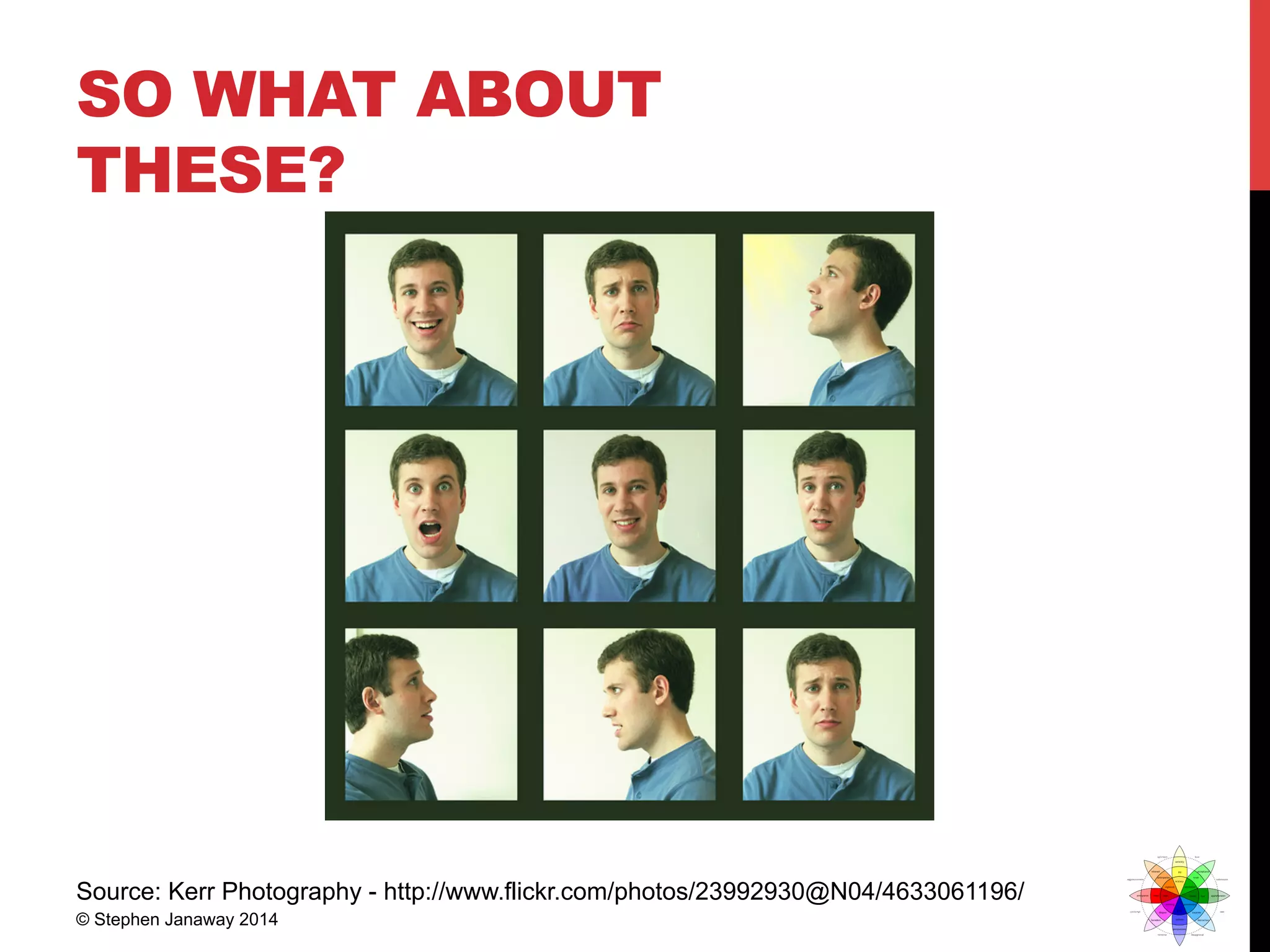
SO WHAT ABOUT
THESE?
Source: Kerr Photography - http://www.flickr.com/photos/23992930@N04/4633061196/
© Stephen Janaway 2014
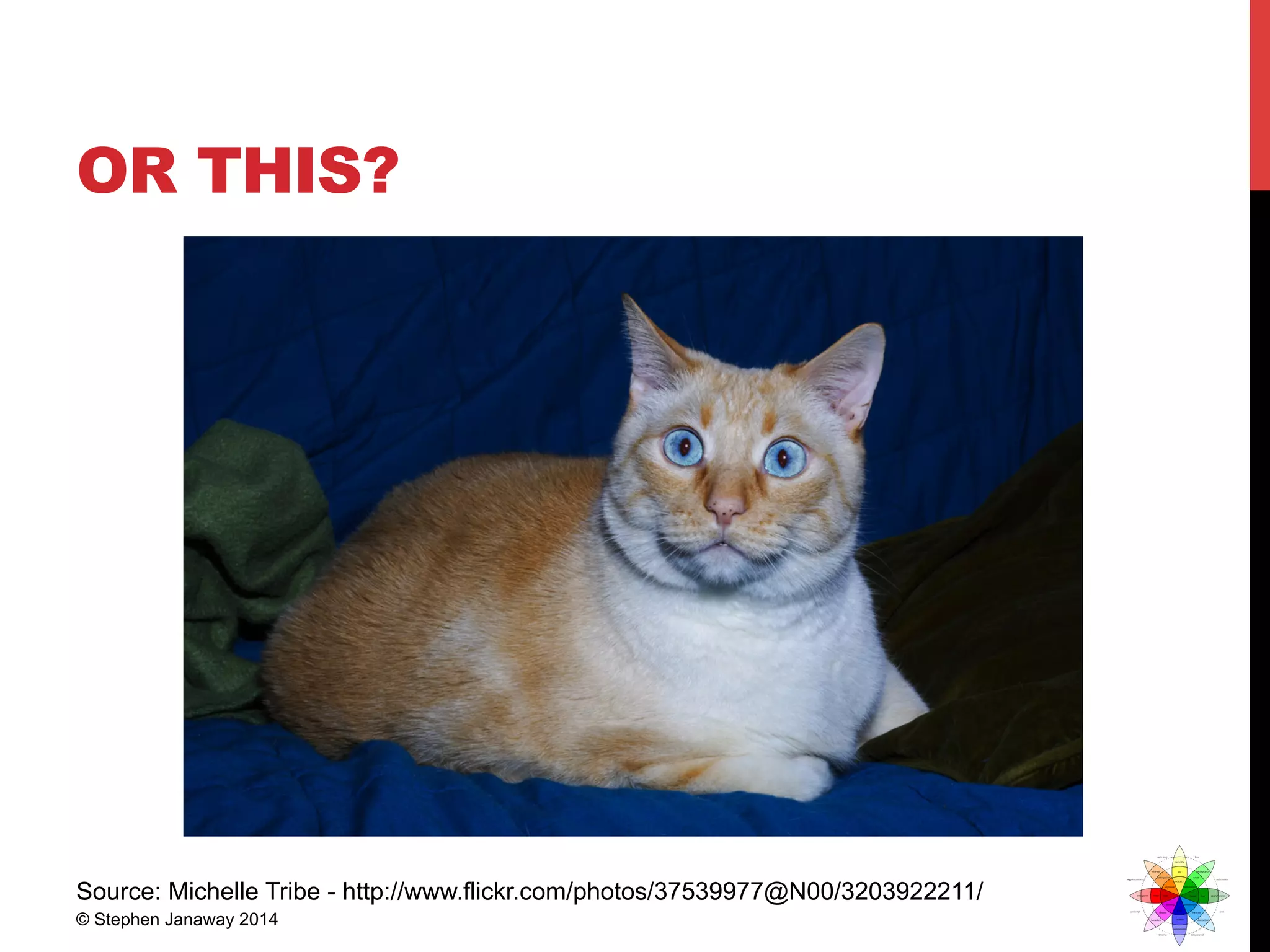
OR THIS?
Source: Michelle Tribe - http://www.flickr.com/photos/37539977@N00/3203922211/
© Stephen Janaway 2014
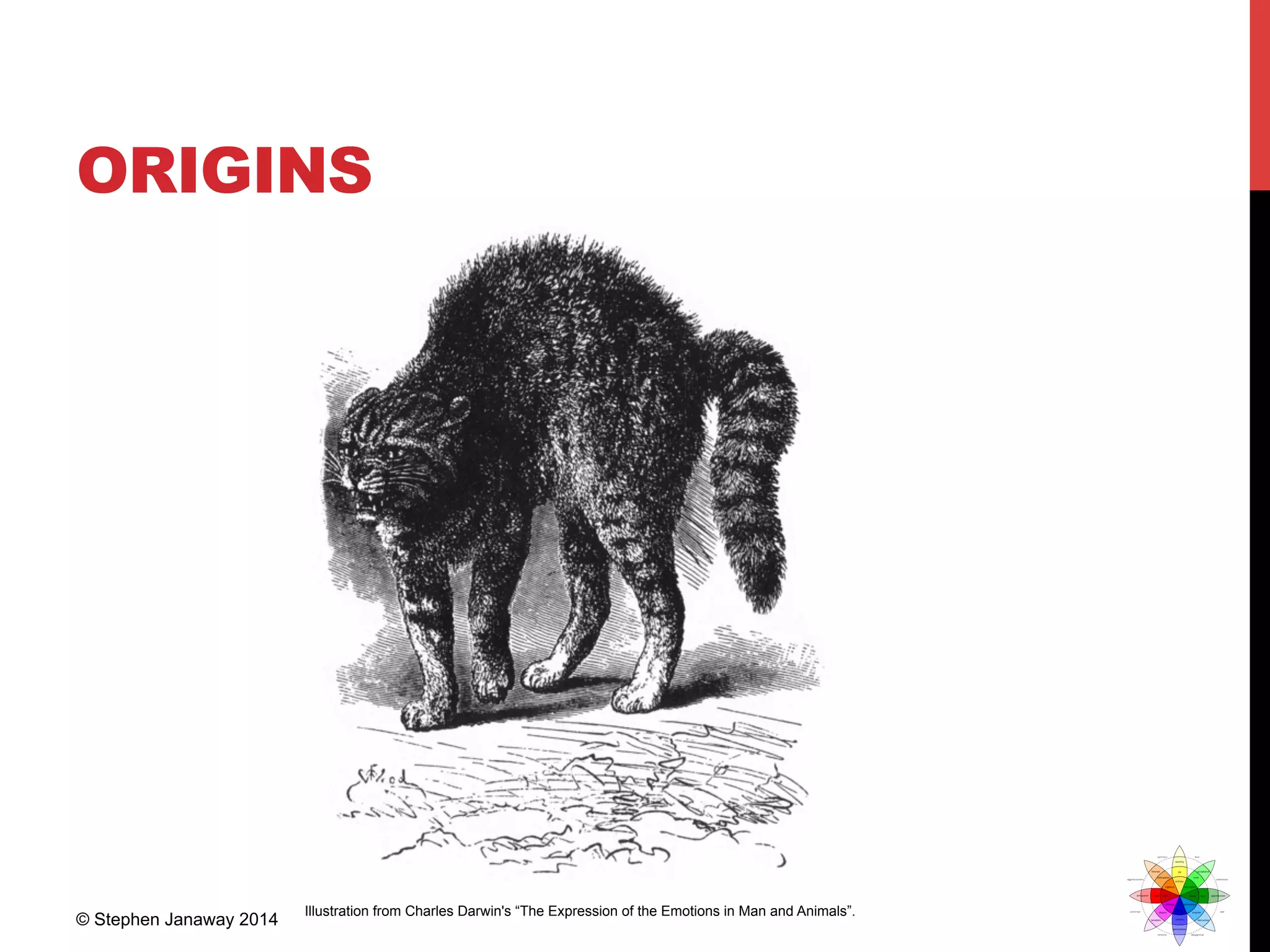
ORIGINS
Illustration from Charles Darwin's “The Expression of the Emotions in Man and Animals”.
© Stephen Janaway 2014
WE NEED TO
BETTER
UNDERSTAND
OUR EMOTIONS
© Stephen Janaway 2014
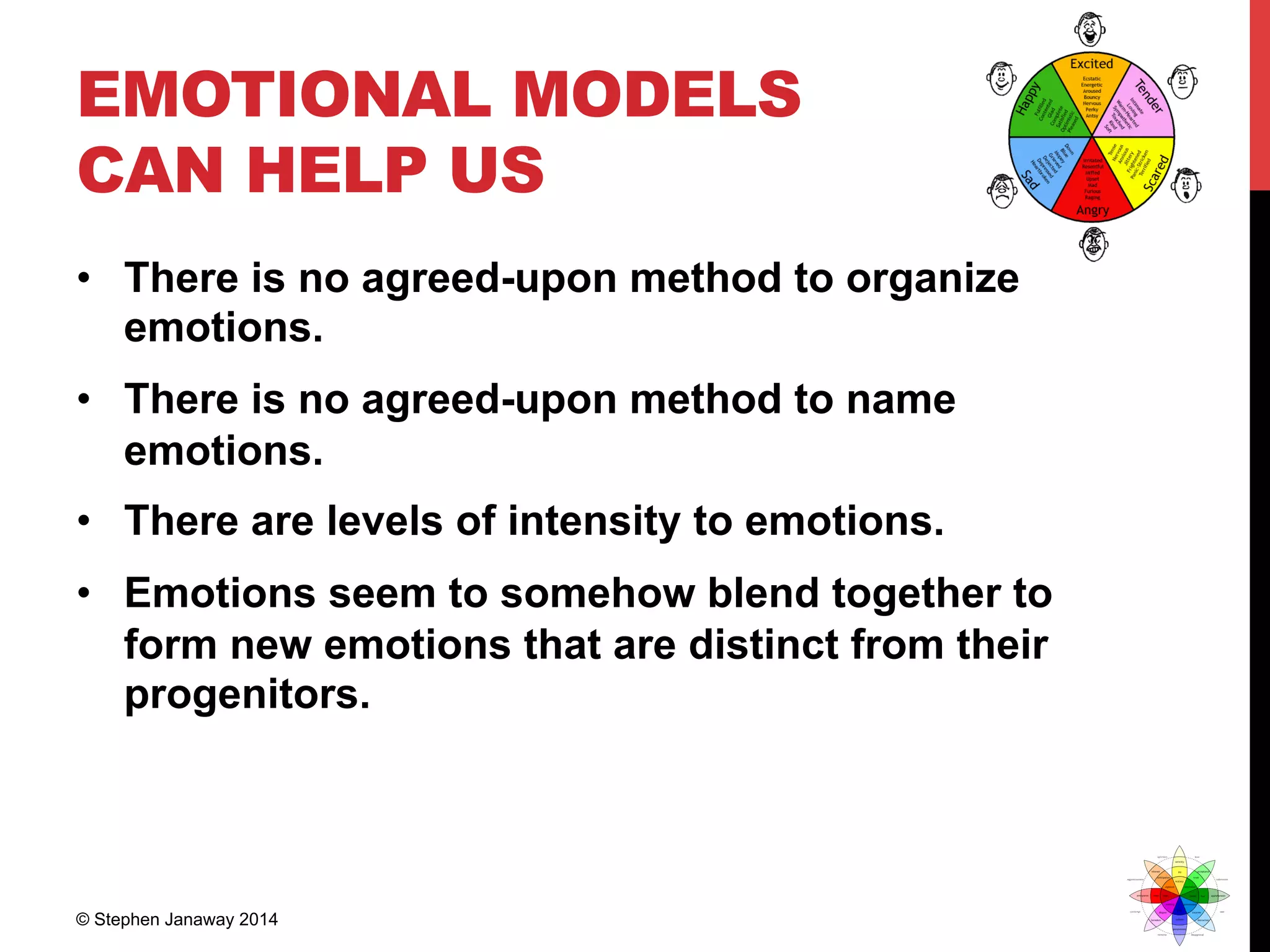
EMOTIONAL MODELS
CAN HELP US
•  There is no agreed-upon method to organize
emotions.
•  There is no agreed-upon method to name
emotions.
•  There are levels of intensity to emotions.
•  Emotions seem to somehow blend together to
form new emotions that are distinct from their
progenitors.
© Stephen Janaway 2014
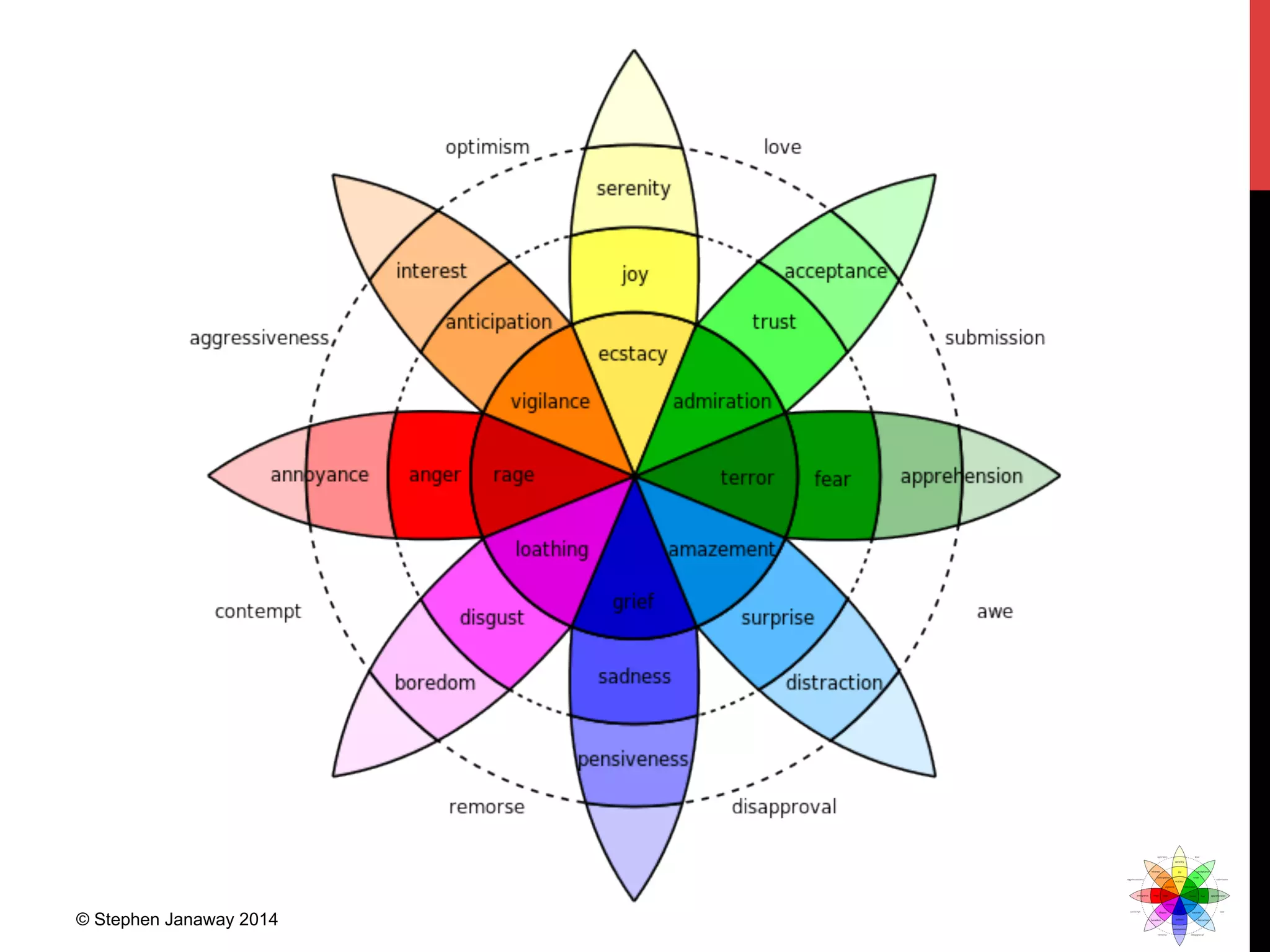
ROBERT
PLUTCHIK
WHEEL OF EMOTION
© Stephen Janaway 2014
10 POSTULATES
FROM PLUTCHIK
•  The concept of emotion is applicable to all evolutionary levels and applies to all
animals including humans.
•  Emotions have an evolutionary history and have evolved various forms of
expression in different species.
•  Emotions served an adaptive role in helping organisms deal with key survival
issues posed by the environment.
•  Despite different forms of expression of emotions in different species, there are
certain common elements, or prototype patterns, that can be identified.
•  There is a small number of basic, primary, or prototype emotions.
•  All other emotions are mixed or derivative states; that is, they occur as
combinations, mixtures, or compounds of the primary emotions.
•  Primary emotions are hypothetical constructs or idealized states whose properties
and characteristics can only be inferred from various kinds of evidence.
•  Primary emotions can be conceptualized in terms of pairs of polar opposites.
•  All emotions vary in their degree of similarity to one another.
•  Each emotion can exist in varying degrees of intensity or levels of arousal.
© Stephen Janaway 2014
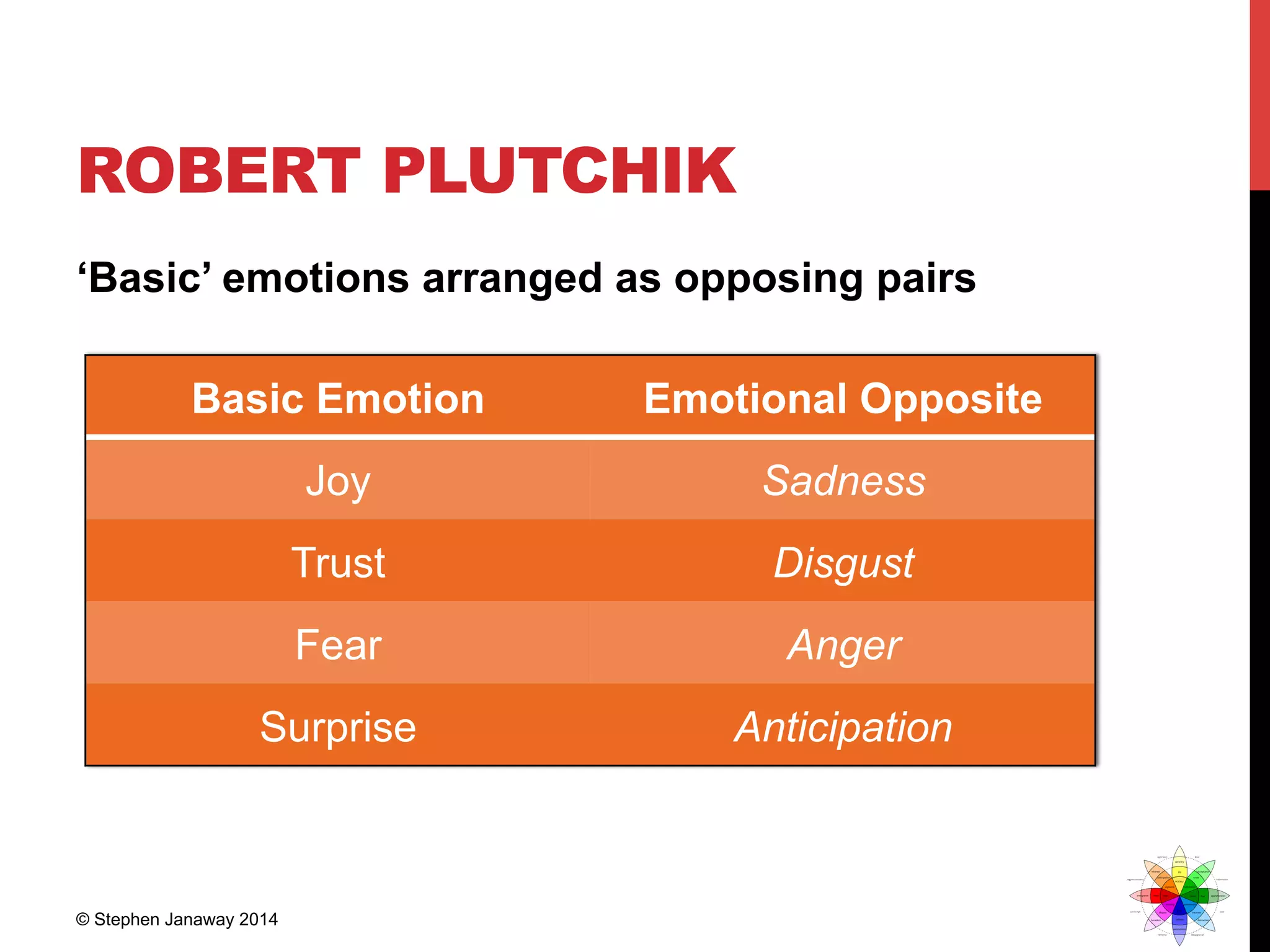
ROBERT PLUTCHIK
‘Basic’ emotions arranged as opposing pairs
Basic Emotion Emotional Opposite
Joy Sadness
Trust Disgust
Fear Anger
Surprise Anticipation
© Stephen Janaway 2014
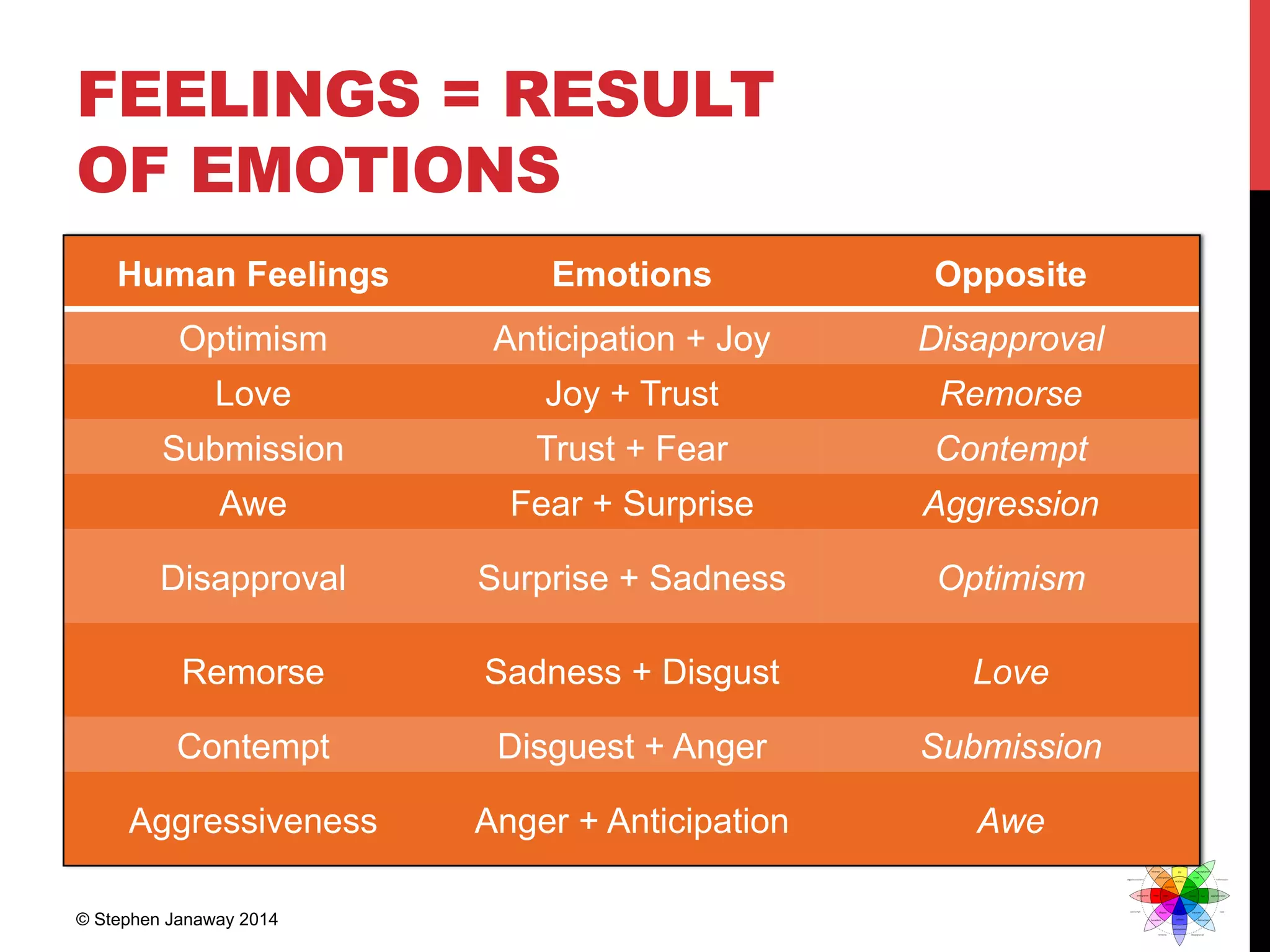
FEELINGS = RESULT
OF EMOTIONS
Human Feelings Emotions Opposite
Optimism Anticipation + Joy Disapproval
Love Joy + Trust Remorse
Submission Trust + Fear Contempt
Awe Fear + Surprise Aggression
Disapproval Surprise + Sadness Optimism
Remorse Sadness + Disgust Love
Contempt Disguest + Anger Submission
Aggressiveness Anger + Anticipation Awe
© Stephen Janaway 2014
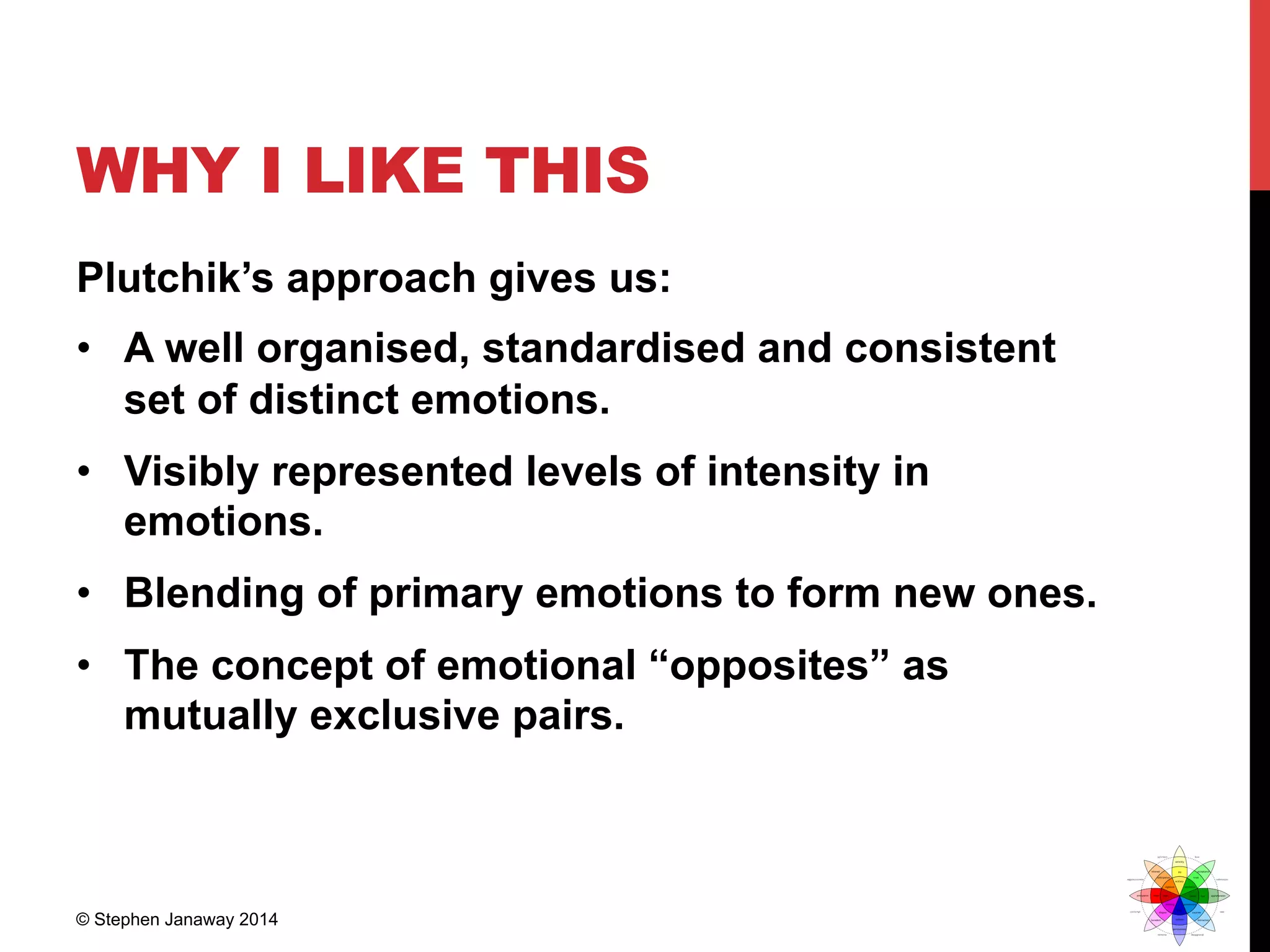
WHY I LIKE THIS
Plutchik’s approach gives us:
•  A well organised, standardised and consistent
set of distinct emotions.
•  Visibly represented levels of intensity in
emotions.
•  Blending of primary emotions to form new ones.
•  The concept of emotional “opposites” as
mutually exclusive pairs.
© Stephen Janaway 2014
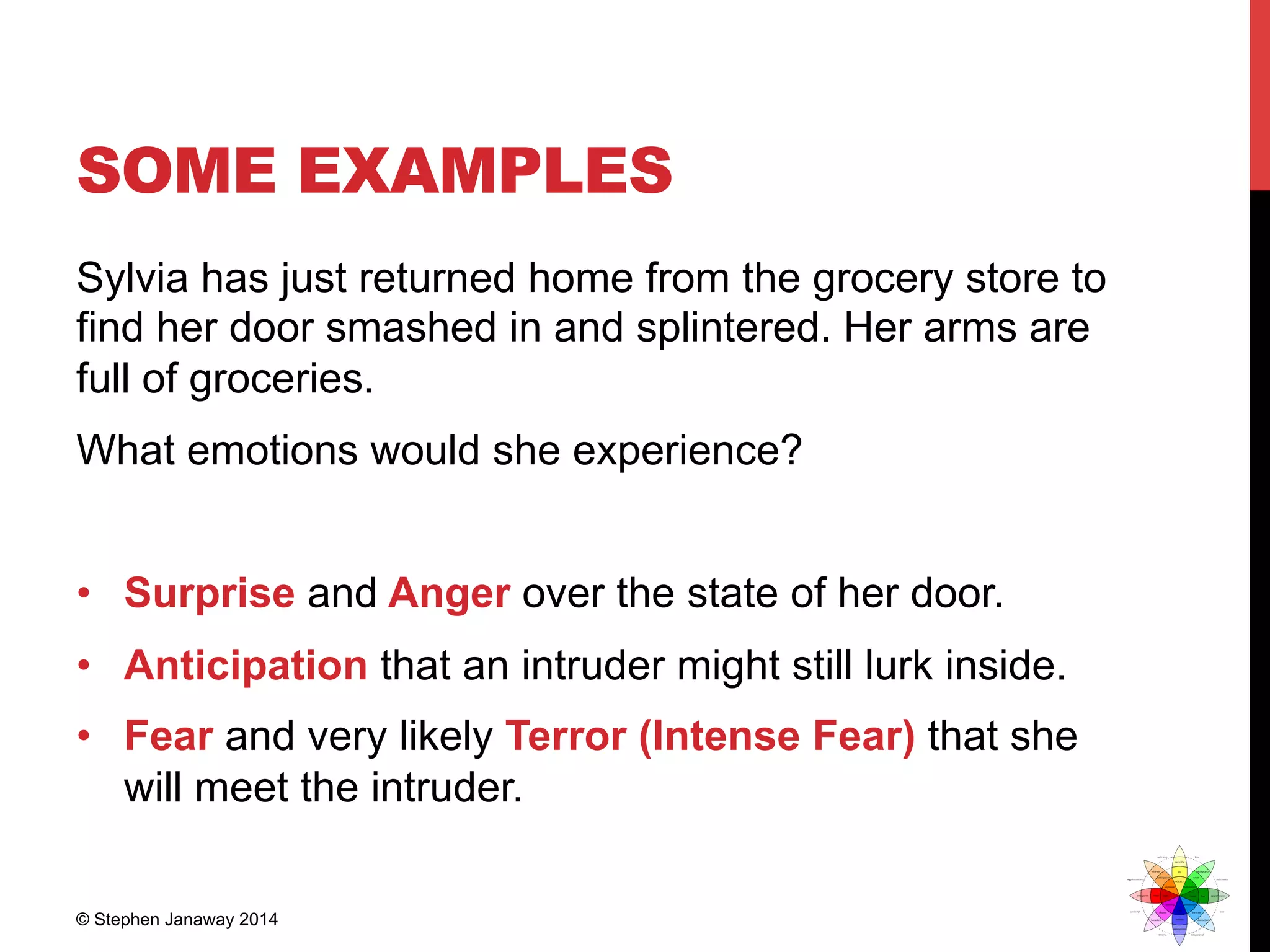
SOME EXAMPLES
Sylvia has just returned home from the grocery store to
find her door smashed in and splintered. Her arms are
full of groceries.
What emotions would she experience?
•  Surprise and Anger over the state of her door.
•  Anticipation that an intruder might still lurk inside.
•  Fear and very likely Terror (Intense Fear) that she
will meet the intruder.
© Stephen Janaway 2014
SOME EXAMPLES
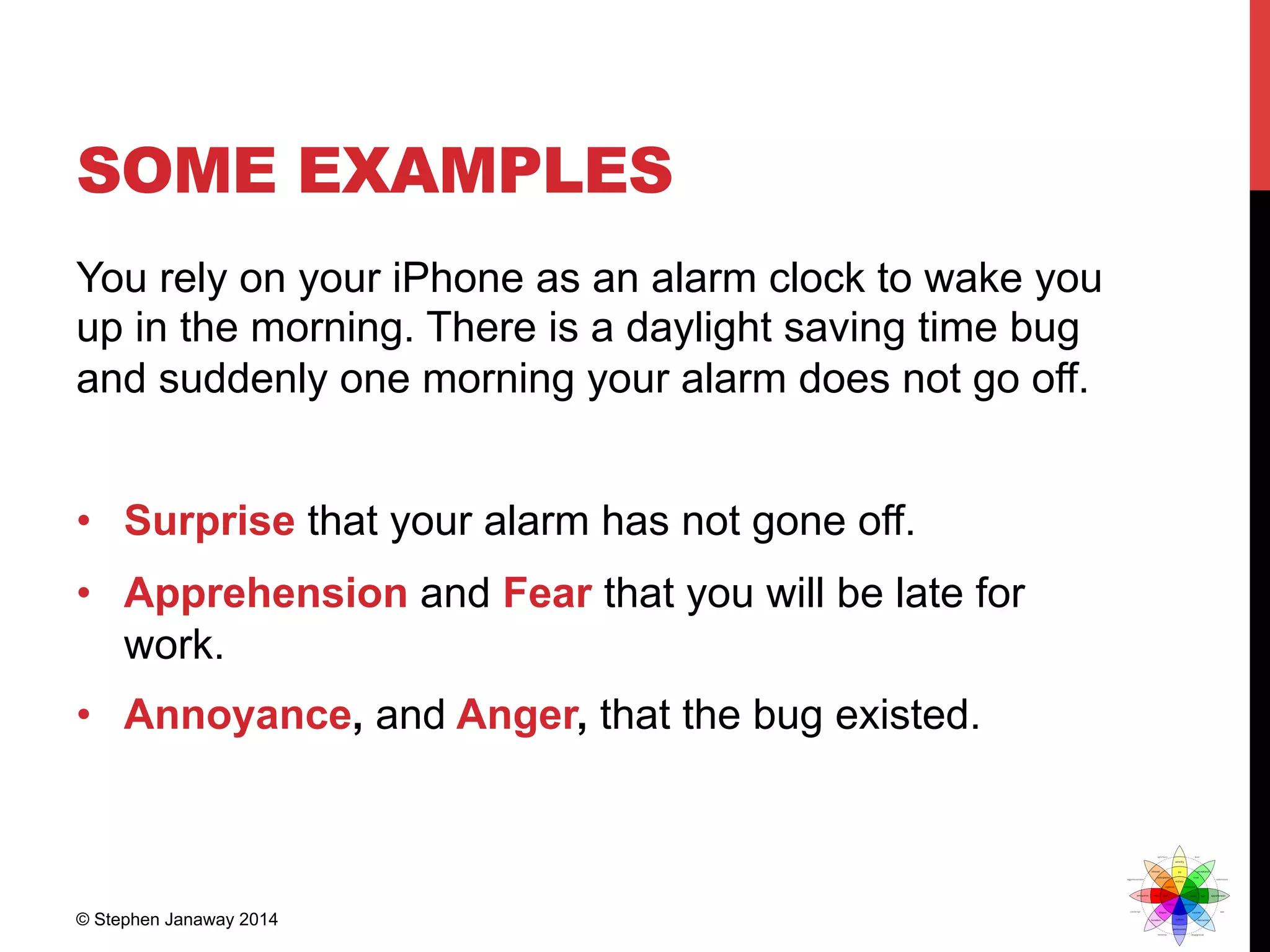
You rely on your iPhone as an alarm clock to wake you
up in the morning. There is a daylight saving time bug
and suddenly one morning your alarm does not go off.
•  Surprise that your alarm has not gone off.
•  Apprehension and Fear that you will be late for
work.
•  Annoyance, and Anger, that the bug existed.
© Stephen Janaway 2014
SOME EXAMPLES
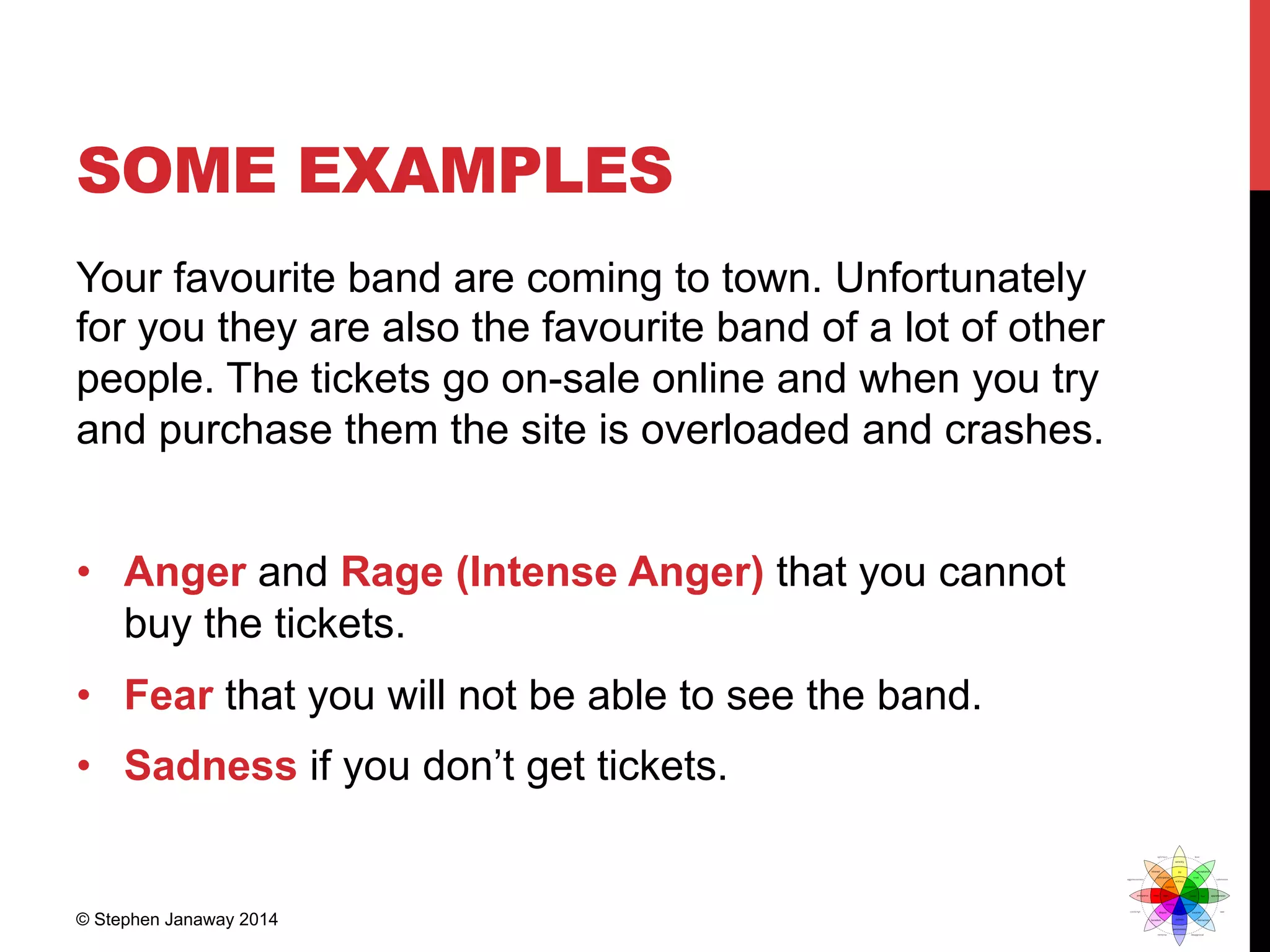
Your favourite band are coming to town. Unfortunately
for you they are also the favourite band of a lot of other
people. The tickets go on-sale online and when you try
and purchase them the site is overloaded and crashes.
•  Anger and Rage (Intense Anger) that you cannot
buy the tickets.
•  Fear that you will not be able to see the band.
•  Sadness if you don’t get tickets.
© Stephen Janaway 2014
SOME EXAMPLES
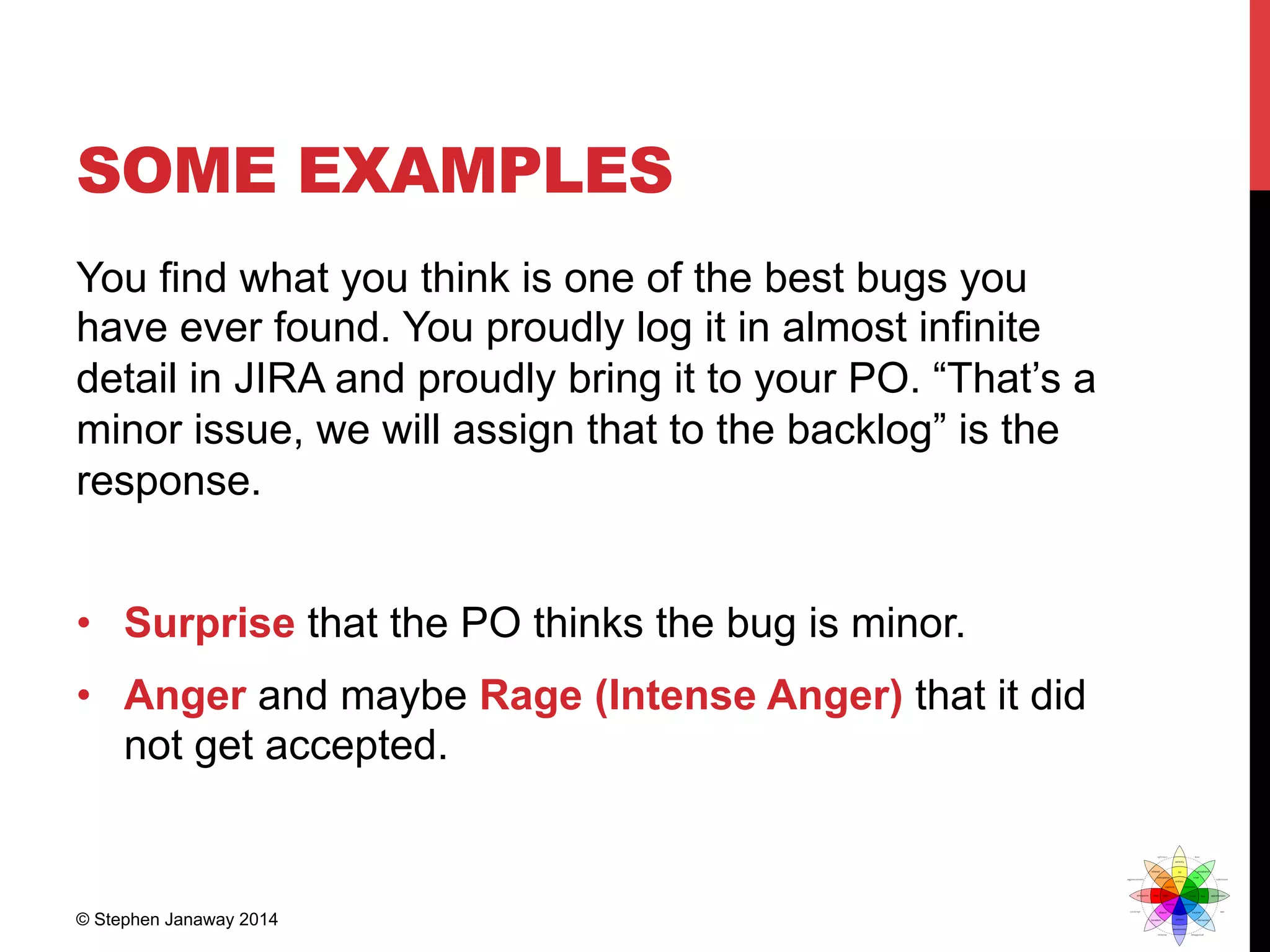
You find what you think is one of the best bugs you
have ever found. You proudly log it in almost infinite
detail in JIRA and proudly bring it to your PO. “That’s a
minor issue, we will assign that to the backlog” is the
response.
•  Surprise that the PO thinks the bug is minor.
•  Anger and maybe Rage (Intense Anger) that it did
not get accepted.
© Stephen Janaway 2014
SOME EXAMPLES
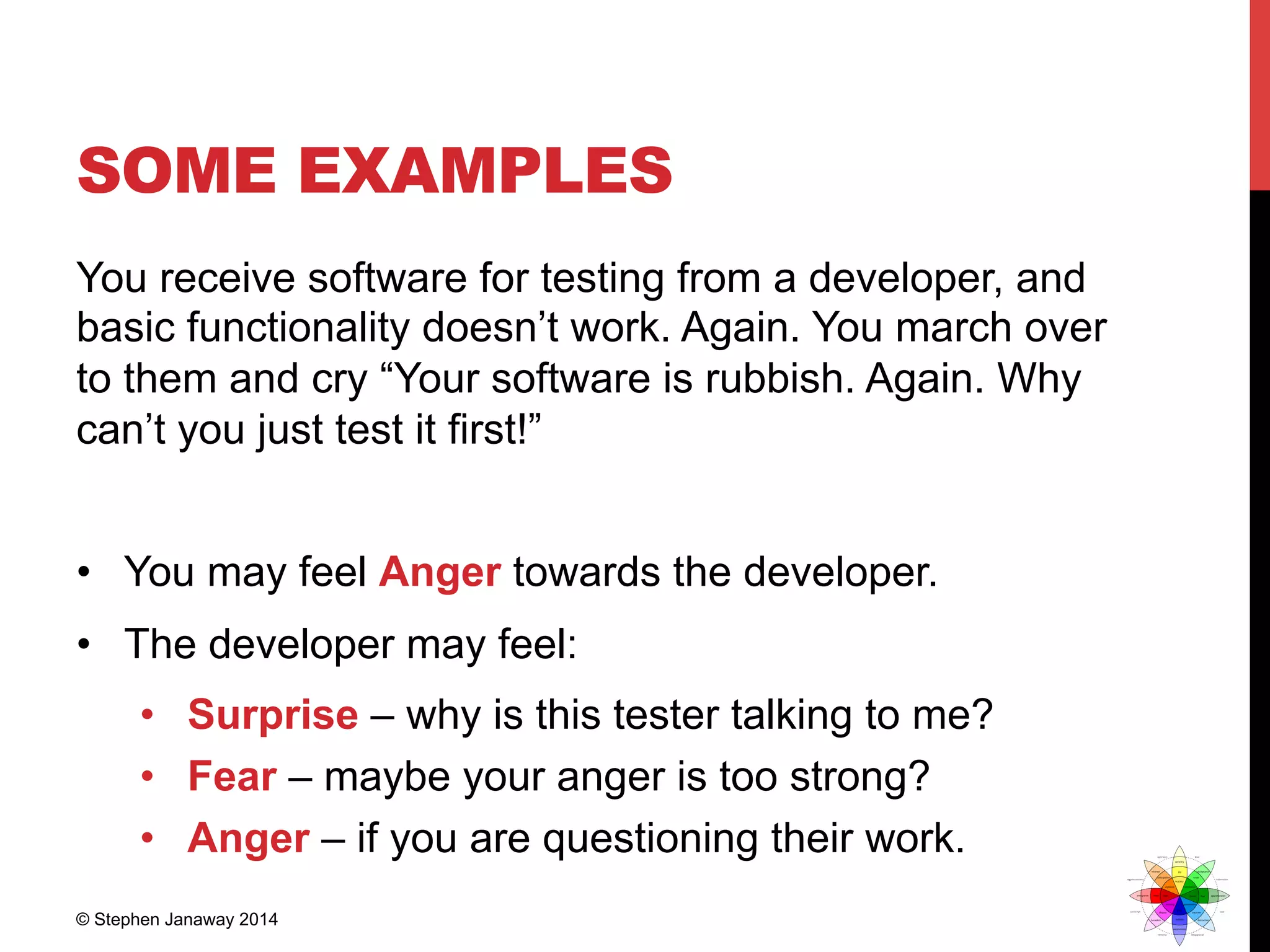
You receive software for testing from a developer, and
basic functionality doesn’t work. Again. You march over
to them and cry “Your software is rubbish. Again. Why
can’t you just test it first!”
•  You may feel Anger towards the developer.
•  The developer may feel:
•  Surprise – why is this tester talking to me?
•  Fear – maybe your anger is too strong?
•  Anger – if you are questioning their work.
© Stephen Janaway 2014
SOME EXAMPLES
Your team successfully launches version 1 of your new
product into the market and first day usage statistics
indicate you’ve got a hit on your hands. You all
celebrate.
•  Joy and Ecstasy because the job has been well
done.
•  Trust and Admiration (Intense Trust) towards
each other.
•  Surprise and Amazement (Intense Surprise)? J
© Stephen Janaway 2014
HUGO
LÖVHEIM
CUBE OF EMOTION
© Stephen Janaway 2014
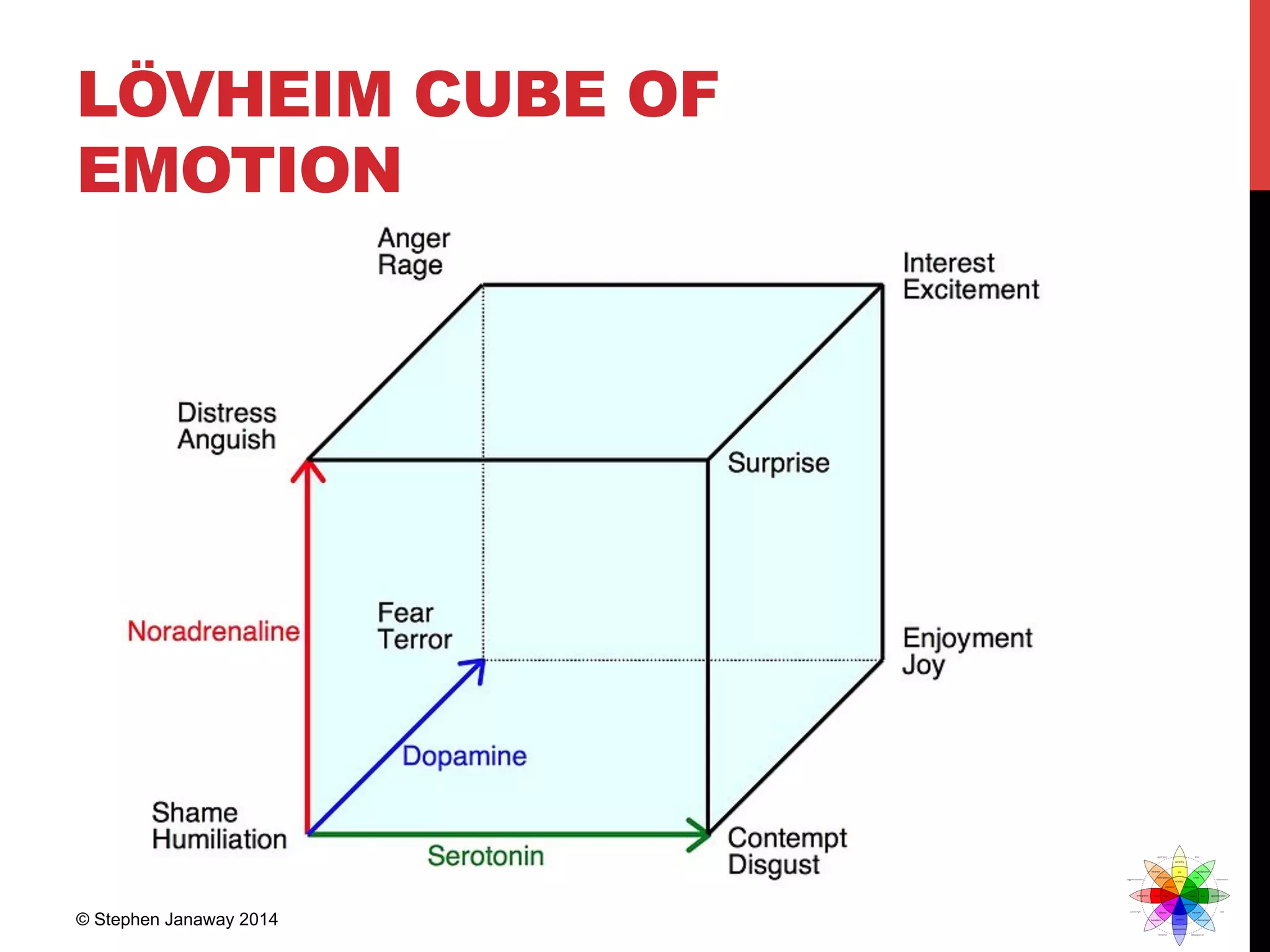
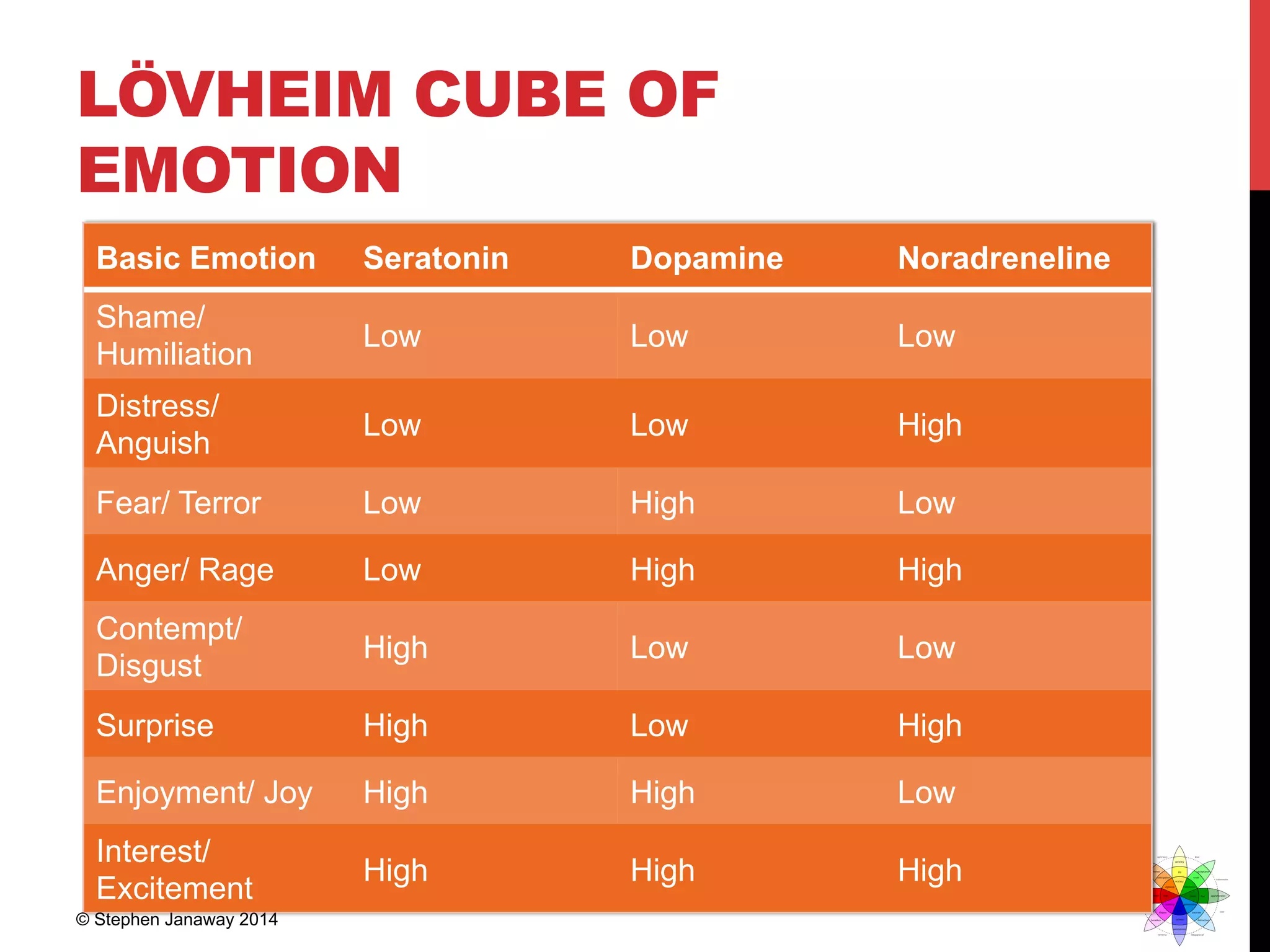
LÖVHEIM CUBE OF
EMOTION
The relationship between the monoamine
neurotransmitters and the emotions.
How your brain works chemically and the
emotions you experience as a result.
© Stephen Janaway 2014
LÖVHEIM CUBE OF
EMOTION
© Stephen Janaway 2014
LÖVHEIM CUBE OF
EMOTION
Basic Emotion Seratonin Dopamine Noradreneline
Shame/
Humiliation
Low Low Low
Distress/
Anguish
Low Low High
Fear/ Terror Low High Low
Anger/ Rage Low High High
Contempt/
Disgust
High Low Low
Surprise High Low High
Enjoyment/ Joy High High Low
Interest/
Excitement
High High High
© Stephen Janaway 2014
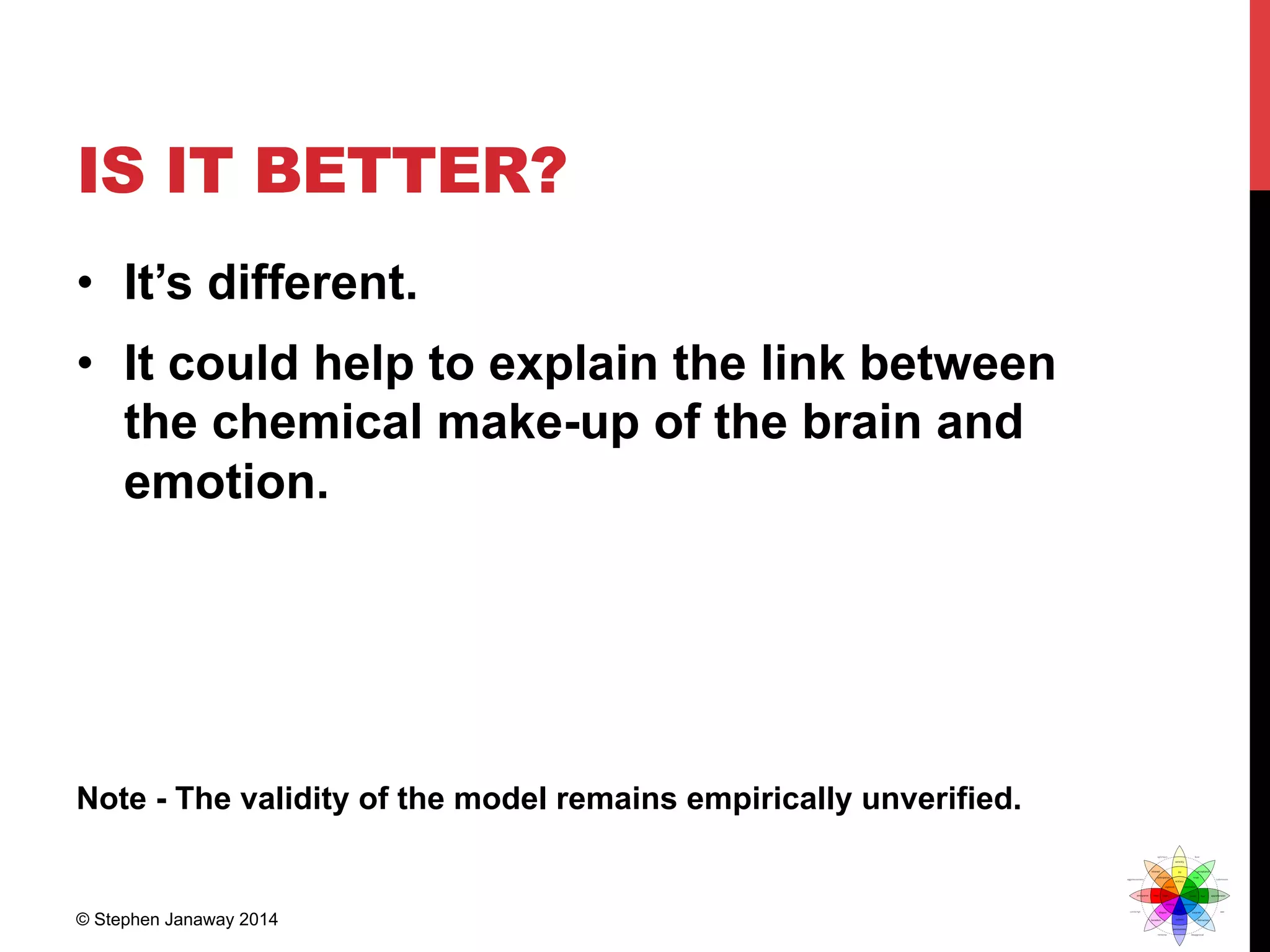
IS IT BETTER?
•  It’s different.
•  It could help to explain the link between
the chemical make-up of the brain and
emotion.
Note - The validity of the model remains empirically unverified.
© Stephen Janaway 2014
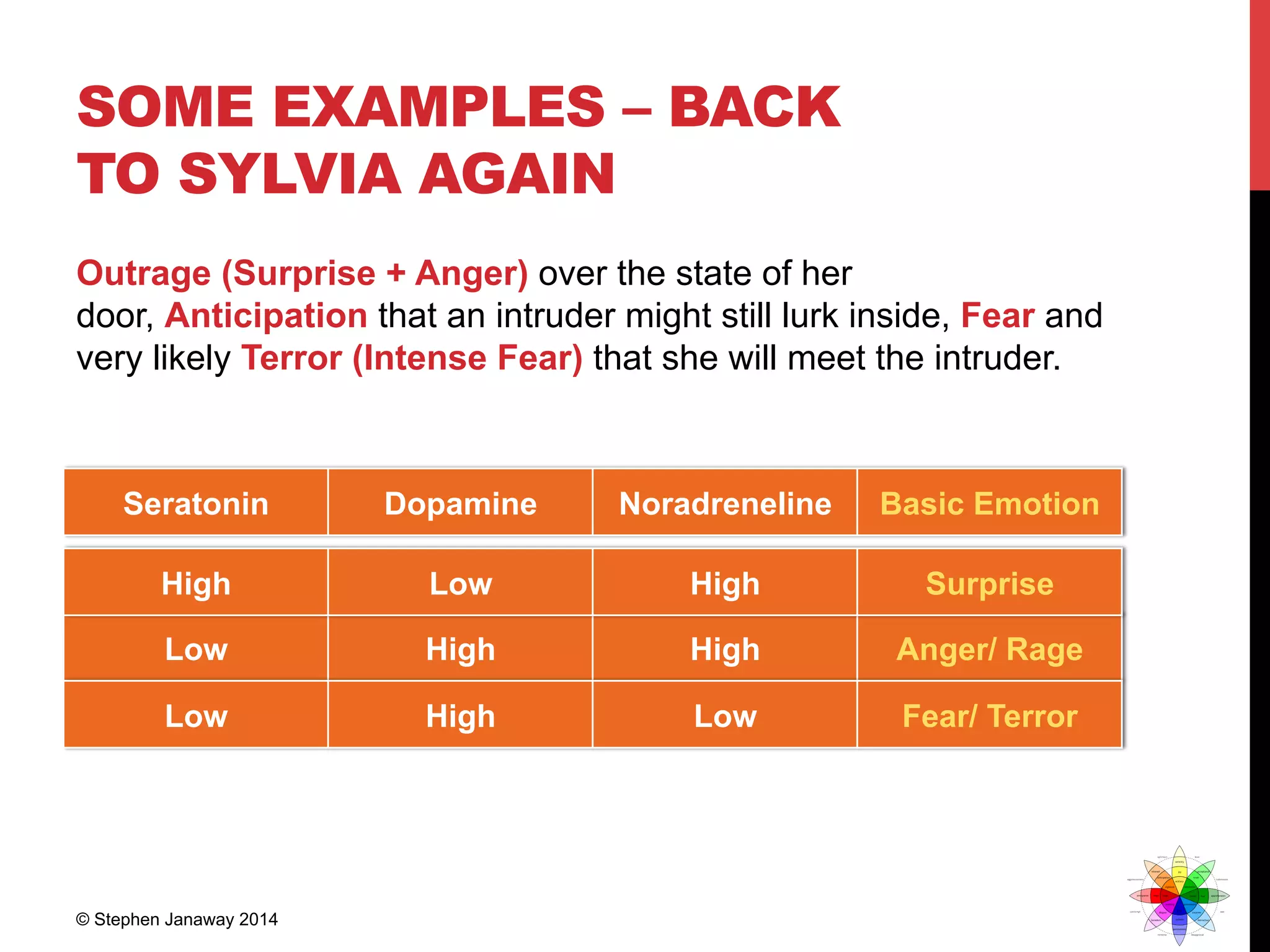
SOME EXAMPLES – BACK
TO SYLVIA AGAIN
Outrage (Surprise + Anger) over the state of her
door, Anticipation that an intruder might still lurk inside, Fear and
very likely Terror (Intense Fear) that she will meet the intruder.
Seratonin Dopamine Noradreneline Basic Emotion
Low High High Anger/ Rage
Low High Low Fear/ Terror
High Low High Surprise
© Stephen Janaway 2014
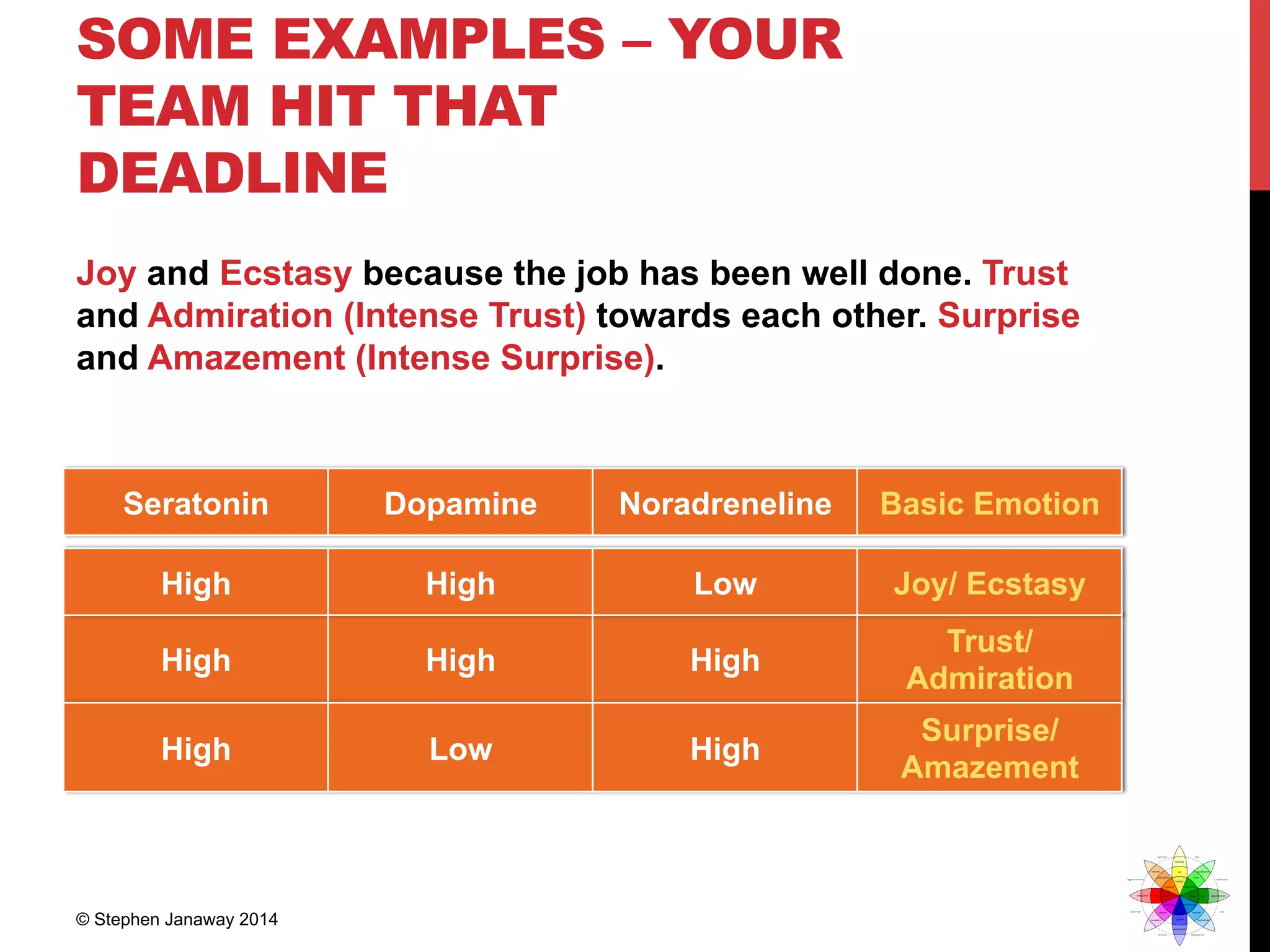
SOME EXAMPLES – YOUR
TEAM HIT THAT
DEADLINE
Joy and Ecstasy because the job has been well done. Trust
and Admiration (Intense Trust) towards each other. Surprise
and Amazement (Intense Surprise).
Seratonin Dopamine Noradreneline Basic Emotion
High High High
Trust/
Admiration
High Low High
Surprise/
Amazement
High High Low Joy/ Ecstasy
© Stephen Janaway 2014
WHAT ABOUT
THE EMOTIONS
YOU FEEL
WHEN
TESTING?
© Stephen Janaway 2014
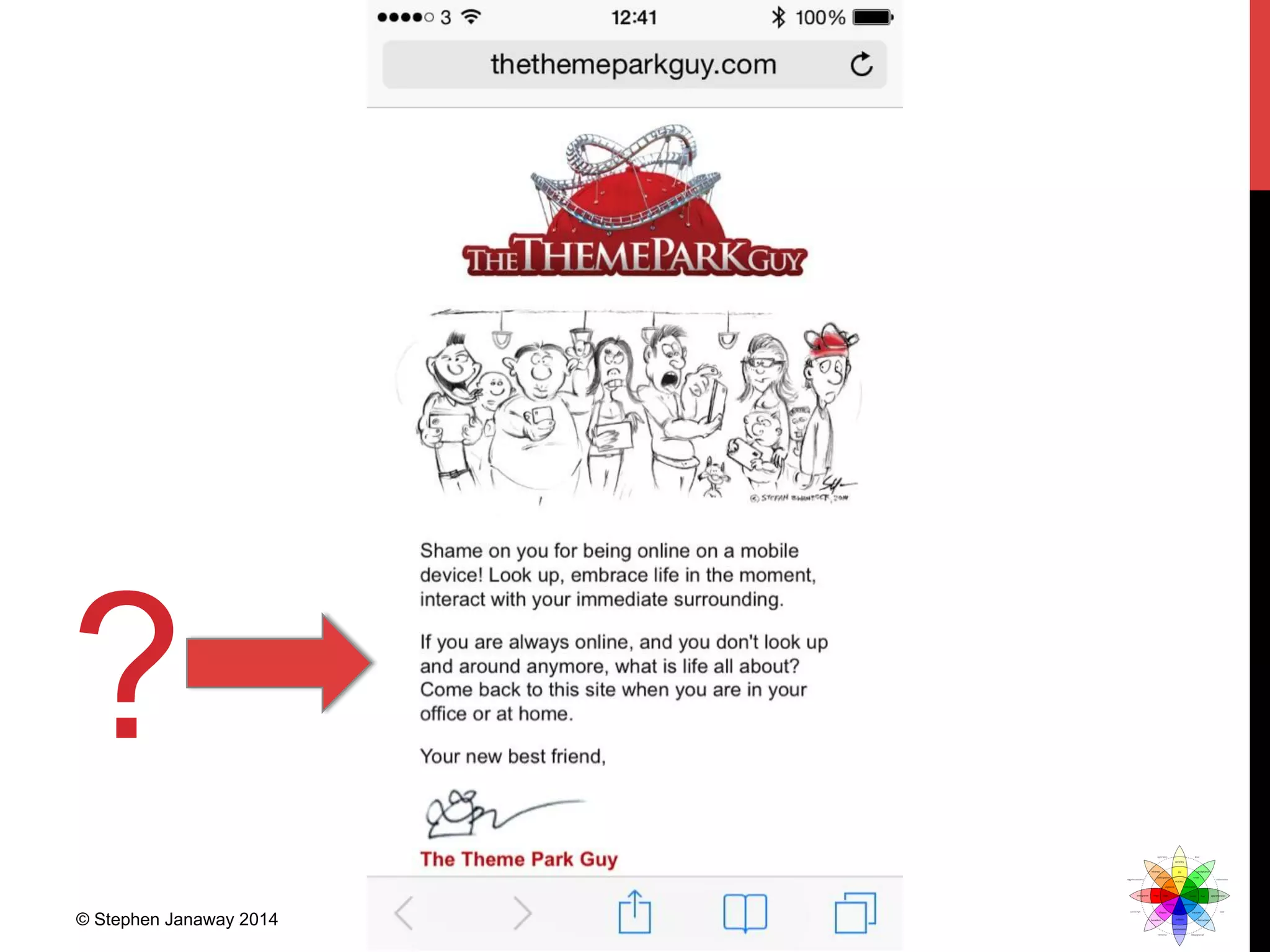
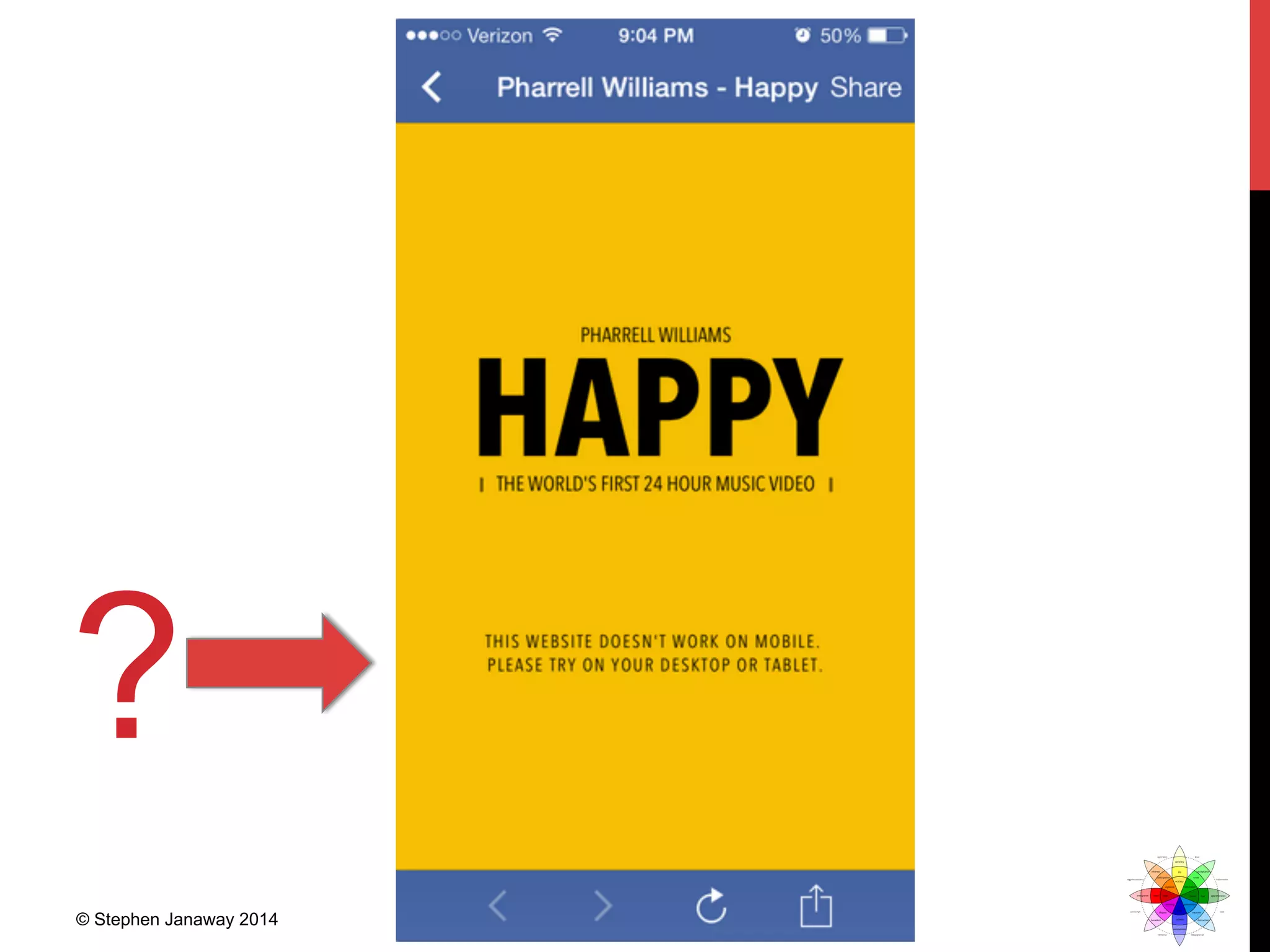
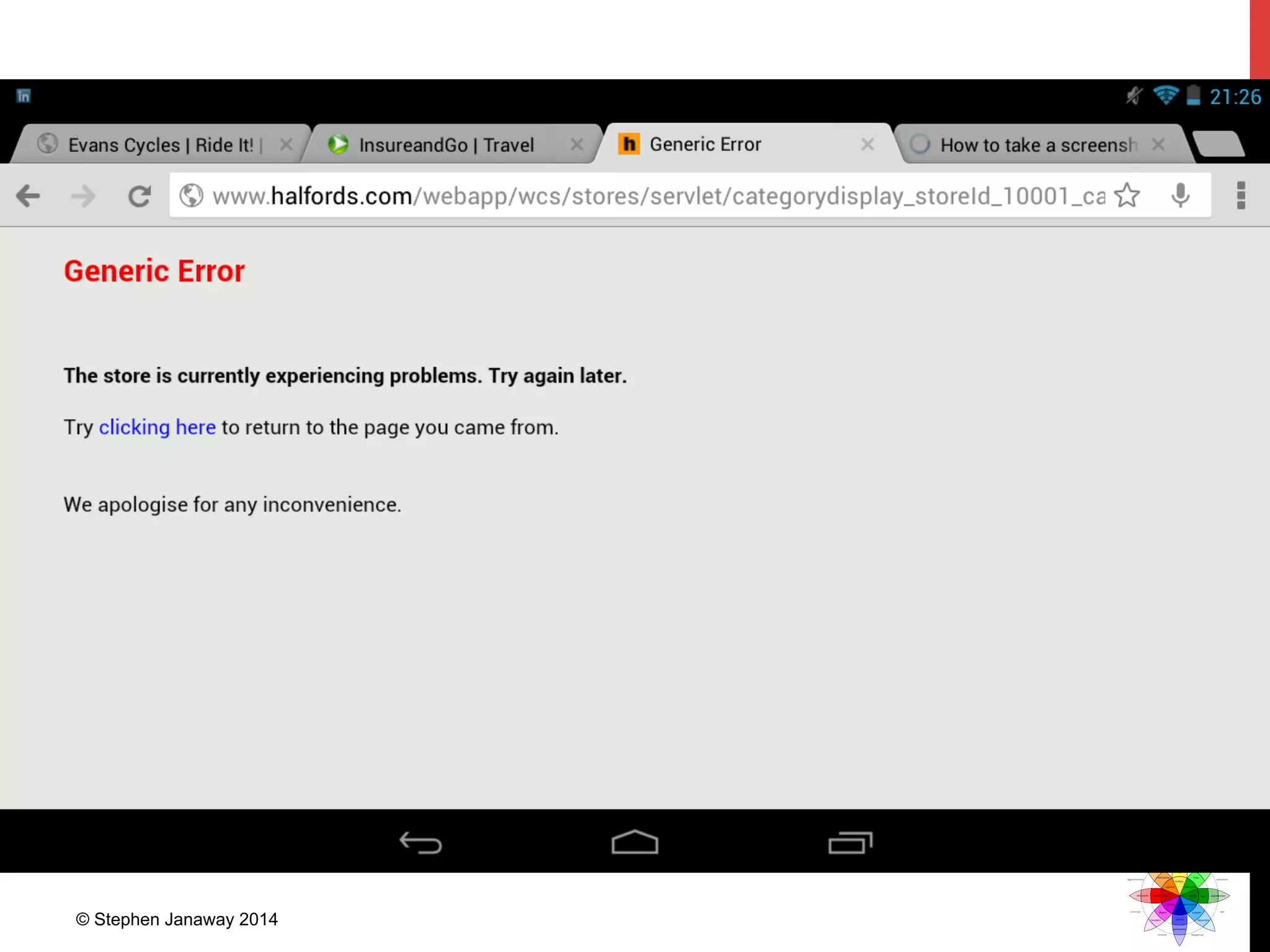
IS THERE A
PROBLEM
HERE?
MICHAEL BOLTON – “EMOTIONS IN
SOFTWARE TESTING”
© Stephen Janaway 2014
?
© Stephen Janaway 2014
?
© Stephen Janaway 2014
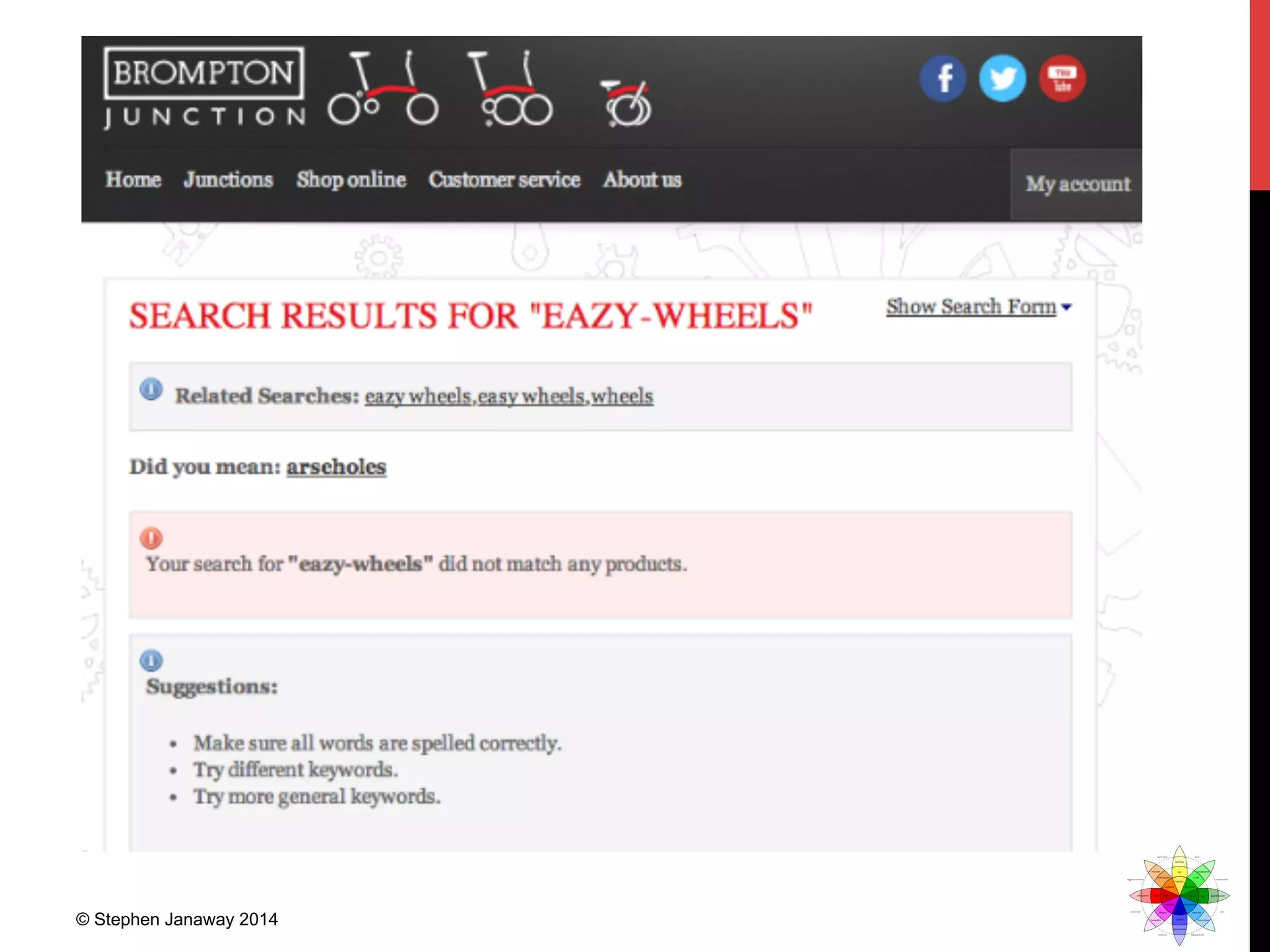
SOMETIMES IT
JUST DOESN’T
SMELL RIGHT…
© Stephen Janaway 2014
FEELINGS ->
EMOTIONS ->
TESTING
© Stephen Janaway 2014
“FEELINGS EXIST. FEELINGS ARE
FACTS… IF YOU CAN’T STAND
DEALING WITH FEELINGS AS
FACTS, THEN YOUR OWN
FEELINGS ARE GETTING IN THE
WAY OF YOUR SUCCESS. AND IF
THAT’S NOT TOUCHY-FEELY, WHAT
IS?”
JERRY WEINBERG
© Stephen Janaway 2014
BUT BE
AWARE OF
EMOTIONAL
BIASES
© Stephen Janaway 2014
SO…..
•  Understanding emotions can help us:
•  Understand how we act.
•  Understand how we should act.
•  Emotional models can help:
•  Plutchik’s Wheel of Emotion.
•  Löheim’s Cube of Emotion.
•  Feeling’s are a powerful testing heuristic:
•  If you feel something when testing then act on it.
© Stephen Janaway 2014
EMOTIONS AND
FEELINGS ARE
SIGNALS.
LOOK INTO WHAT
THEY’RE SIGNALING.
MICHAEL BOLTON
© Stephen Janaway 2014
QUESTIONS
“YOU MUST BE THE MASTER OF YOUR EMOTIONS IF YOU
WISH TO LIVE IN PEACE, FOR HE WHO CAN CONTROL
HIMSELF, BECOMES FREE.”
STEPHEN JANAWAY
@stephenjanaway
www.stephenjanaway.co.uk
© Stephen Janaway 2014

Testing Your Emotions

  • 1.
    TESTING YOUR EMOTIONS AND HOW YOUCAN APPLY SOME PERSONAL LEADERSHIP TO KEEP THEM UNDER CONTROL… © Stephen Janaway 2014
  • 2.
    WHO AM I? STEPHENJANAWAY •  14 years experience in mobile software testing. •  Software testing and test management. •  Main focus on the mobile device and applications area. •  Have worked for companies such as Ericsson, Motorola and Nokia. www.stephenjanaway.co.uk @stephenjanaway © Stephen Janaway 2014
  • 3.
    THANKS TO…. •  RobertPlutchik. •  Hugo Lövheim. •  Jerry Weinberg. •  Michael Bolton. •  And many more…. •  And some cats. © Stephen Janaway 2014
  • 4.
    WHY? BECAUSE I BELIEVETHAT UNDERSTANDING OUR EMOTIONS MAKES US BETTER TESTERS © Stephen Janaway 2014
  • 5.
  • 6.
  • 7.
    EMOTIONS CAN HAVE A POWERFUL IMPACTON MEMORY © Stephen Janaway 2014
  • 8.
    WITHOUT EMOTION, WE DON’T REASON WELL. ANTONIODAMASIO, “THE FEELING OF WHAT HAPPENS”. © Stephen Janaway 2014
  • 9.
    FRUSTRATION – A PERSONALSTORY © Stephen Janaway 2014
  • 10.
    WHAT ARE EMOTIONS? The word"emotion" dates back to 1579, when it was adapted from the French word émouvoir, which means "to stir up". However, the earliest precursors of the word likely dates back to the very origins of language. Wikipedia © Stephen Janaway 2014
  • 11.
    WHAT ARE EMOTIONS? •  Discreteand consistent responses to internal or external events which have a particular significance for the organism. •  Brief in duration and consist of a coordinated set of responses, which may include verbal, physiological, behavioral, and neural mechanisms. •  Biologically given and a result of evolution because they provided good solutions to ancient and recurring problems that faced our ancestors. © Stephen Janaway 2014
  • 12.
    WHAT AREN’T THEY? • Feelings - a subjective representation of emotions, private to the individual experiencing them. •  Moods - diffuse affective states that generally last for much longer durations than emotions and are also usually less intense than emotions. •  Affects - a term that describe the topics of emotion, feelings, and moods together. © Stephen Janaway 2014
  • 13.
    HOW CAN WE UNDERSTAND? • Think about the last time you received an emotional response - How did it make you feel? •  Think about the last time you felt “emotional” - Why was it? How did it make you feel? Did you try and hide it? © Stephen Janaway 2014
  • 14.
    SO WHAT ABOUT THESE? Source:Kerr Photography - http://www.flickr.com/photos/23992930@N04/4633061196/ © Stephen Janaway 2014
  • 15.
    OR THIS? Source: MichelleTribe - http://www.flickr.com/photos/37539977@N00/3203922211/ © Stephen Janaway 2014
  • 16.
    ORIGINS Illustration from CharlesDarwin's “The Expression of the Emotions in Man and Animals”. © Stephen Janaway 2014
  • 17.
    WE NEED TO BETTER UNDERSTAND OUREMOTIONS © Stephen Janaway 2014
  • 18.
    EMOTIONAL MODELS CAN HELPUS •  There is no agreed-upon method to organize emotions. •  There is no agreed-upon method to name emotions. •  There are levels of intensity to emotions. •  Emotions seem to somehow blend together to form new emotions that are distinct from their progenitors. © Stephen Janaway 2014
  • 19.
  • 20.
    10 POSTULATES FROM PLUTCHIK • The concept of emotion is applicable to all evolutionary levels and applies to all animals including humans. •  Emotions have an evolutionary history and have evolved various forms of expression in different species. •  Emotions served an adaptive role in helping organisms deal with key survival issues posed by the environment. •  Despite different forms of expression of emotions in different species, there are certain common elements, or prototype patterns, that can be identified. •  There is a small number of basic, primary, or prototype emotions. •  All other emotions are mixed or derivative states; that is, they occur as combinations, mixtures, or compounds of the primary emotions. •  Primary emotions are hypothetical constructs or idealized states whose properties and characteristics can only be inferred from various kinds of evidence. •  Primary emotions can be conceptualized in terms of pairs of polar opposites. •  All emotions vary in their degree of similarity to one another. •  Each emotion can exist in varying degrees of intensity or levels of arousal. © Stephen Janaway 2014
  • 21.
    ROBERT PLUTCHIK ‘Basic’ emotionsarranged as opposing pairs Basic Emotion Emotional Opposite Joy Sadness Trust Disgust Fear Anger Surprise Anticipation © Stephen Janaway 2014
  • 22.
    FEELINGS = RESULT OFEMOTIONS Human Feelings Emotions Opposite Optimism Anticipation + Joy Disapproval Love Joy + Trust Remorse Submission Trust + Fear Contempt Awe Fear + Surprise Aggression Disapproval Surprise + Sadness Optimism Remorse Sadness + Disgust Love Contempt Disguest + Anger Submission Aggressiveness Anger + Anticipation Awe © Stephen Janaway 2014
  • 23.
  • 24.
    WHY I LIKETHIS Plutchik’s approach gives us: •  A well organised, standardised and consistent set of distinct emotions. •  Visibly represented levels of intensity in emotions. •  Blending of primary emotions to form new ones. •  The concept of emotional “opposites” as mutually exclusive pairs. © Stephen Janaway 2014
  • 25.
    SOME EXAMPLES Sylvia hasjust returned home from the grocery store to find her door smashed in and splintered. Her arms are full of groceries. What emotions would she experience? •  Surprise and Anger over the state of her door. •  Anticipation that an intruder might still lurk inside. •  Fear and very likely Terror (Intense Fear) that she will meet the intruder. © Stephen Janaway 2014
  • 26.
    SOME EXAMPLES You relyon your iPhone as an alarm clock to wake you up in the morning. There is a daylight saving time bug and suddenly one morning your alarm does not go off. •  Surprise that your alarm has not gone off. •  Apprehension and Fear that you will be late for work. •  Annoyance, and Anger, that the bug existed. © Stephen Janaway 2014
  • 27.
    SOME EXAMPLES Your favouriteband are coming to town. Unfortunately for you they are also the favourite band of a lot of other people. The tickets go on-sale online and when you try and purchase them the site is overloaded and crashes. •  Anger and Rage (Intense Anger) that you cannot buy the tickets. •  Fear that you will not be able to see the band. •  Sadness if you don’t get tickets. © Stephen Janaway 2014
  • 28.
    SOME EXAMPLES You findwhat you think is one of the best bugs you have ever found. You proudly log it in almost infinite detail in JIRA and proudly bring it to your PO. “That’s a minor issue, we will assign that to the backlog” is the response. •  Surprise that the PO thinks the bug is minor. •  Anger and maybe Rage (Intense Anger) that it did not get accepted. © Stephen Janaway 2014
  • 29.
    SOME EXAMPLES You receivesoftware for testing from a developer, and basic functionality doesn’t work. Again. You march over to them and cry “Your software is rubbish. Again. Why can’t you just test it first!” •  You may feel Anger towards the developer. •  The developer may feel: •  Surprise – why is this tester talking to me? •  Fear – maybe your anger is too strong? •  Anger – if you are questioning their work. © Stephen Janaway 2014
  • 30.
    SOME EXAMPLES Your teamsuccessfully launches version 1 of your new product into the market and first day usage statistics indicate you’ve got a hit on your hands. You all celebrate. •  Joy and Ecstasy because the job has been well done. •  Trust and Admiration (Intense Trust) towards each other. •  Surprise and Amazement (Intense Surprise)? J © Stephen Janaway 2014
  • 31.
  • 32.
    LÖVHEIM CUBE OF EMOTION Therelationship between the monoamine neurotransmitters and the emotions. How your brain works chemically and the emotions you experience as a result. © Stephen Janaway 2014
  • 33.
    LÖVHEIM CUBE OF EMOTION ©Stephen Janaway 2014
  • 34.
    LÖVHEIM CUBE OF EMOTION BasicEmotion Seratonin Dopamine Noradreneline Shame/ Humiliation Low Low Low Distress/ Anguish Low Low High Fear/ Terror Low High Low Anger/ Rage Low High High Contempt/ Disgust High Low Low Surprise High Low High Enjoyment/ Joy High High Low Interest/ Excitement High High High © Stephen Janaway 2014
  • 35.
    IS IT BETTER? • It’s different. •  It could help to explain the link between the chemical make-up of the brain and emotion. Note - The validity of the model remains empirically unverified. © Stephen Janaway 2014
  • 36.
    SOME EXAMPLES –BACK TO SYLVIA AGAIN Outrage (Surprise + Anger) over the state of her door, Anticipation that an intruder might still lurk inside, Fear and very likely Terror (Intense Fear) that she will meet the intruder. Seratonin Dopamine Noradreneline Basic Emotion Low High High Anger/ Rage Low High Low Fear/ Terror High Low High Surprise © Stephen Janaway 2014
  • 37.
    SOME EXAMPLES –YOUR TEAM HIT THAT DEADLINE Joy and Ecstasy because the job has been well done. Trust and Admiration (Intense Trust) towards each other. Surprise and Amazement (Intense Surprise). Seratonin Dopamine Noradreneline Basic Emotion High High High Trust/ Admiration High Low High Surprise/ Amazement High High Low Joy/ Ecstasy © Stephen Janaway 2014
  • 38.
    WHAT ABOUT THE EMOTIONS YOUFEEL WHEN TESTING? © Stephen Janaway 2014
  • 39.
    IS THERE A PROBLEM HERE? MICHAELBOLTON – “EMOTIONS IN SOFTWARE TESTING” © Stephen Janaway 2014
  • 40.
  • 41.
  • 42.
  • 43.
  • 44.
    SOMETIMES IT JUST DOESN’T SMELLRIGHT… © Stephen Janaway 2014
  • 45.
  • 46.
    “FEELINGS EXIST. FEELINGSARE FACTS… IF YOU CAN’T STAND DEALING WITH FEELINGS AS FACTS, THEN YOUR OWN FEELINGS ARE GETTING IN THE WAY OF YOUR SUCCESS. AND IF THAT’S NOT TOUCHY-FEELY, WHAT IS?” JERRY WEINBERG © Stephen Janaway 2014
  • 47.
  • 48.
    SO….. •  Understanding emotionscan help us: •  Understand how we act. •  Understand how we should act. •  Emotional models can help: •  Plutchik’s Wheel of Emotion. •  Löheim’s Cube of Emotion. •  Feeling’s are a powerful testing heuristic: •  If you feel something when testing then act on it. © Stephen Janaway 2014
  • 49.
    EMOTIONS AND FEELINGS ARE SIGNALS. LOOKINTO WHAT THEY’RE SIGNALING. MICHAEL BOLTON © Stephen Janaway 2014
  • 50.
    QUESTIONS “YOU MUST BETHE MASTER OF YOUR EMOTIONS IF YOU WISH TO LIVE IN PEACE, FOR HE WHO CAN CONTROL HIMSELF, BECOMES FREE.” STEPHEN JANAWAY @stephenjanaway www.stephenjanaway.co.uk © Stephen Janaway 2014